High Intensity Focused Ultrasound (HIFU)
HIFU (High Intensity Focused Ultrasound) has been used extensively in USA, UK, Japan and Europe where clinical studies have shown HIFU to be a safe and effective prostate cancer treatment.

A/Prof Peter Royce was the first Urologist in Melbourne, Australia to use HIFU for the treatment of prostate cancer. Since the first HIFU treatment in November 2005, an increasing number of men have chosen HIFU, instead of radical surgery or radiation therapy, as curative primary treatment or as salvage treatment after previous radiation therapy.
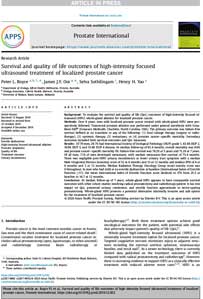
The outcomes of his HIFU prostate cancer treatments have been prospectively recorded and published in a peer reviewed journal Prostate International.
HIFU should be considered as a treatment option by men with early stage prostate cancer, before consenting to radical surgery or radiation treatment, otherwise the opportunity for HIFU treatment will have been overlooked and lost forever.
Why Is HIFU A Beneficial Treatment For Prostate Cancer
- Lower complication and side effects
Advice based on our own prospective data of HIFU treated patients- Short term complications
- Some patients experience difficulty passing urine and may require a catheter for an extra week, failing which they would require a Cystoscopy as a day procedure, to clear the treated tissue from the prostate. Antibiotics are routinely prescribed during the recovery period. Our own studies on HIFU treated patients showed no overall increase in urinary symptoms more than 12 months after treatment.
- A small number of patients may experience mild redness or swelling around the scrotum and penis that resolves within 1-2 weeks.
- <10% patients experience mild rectal symptoms such as bleeding, loose stools or mucus in stools that resolves within a week.
- <1% of patients have a rectal fistula, which is a communication between the prostate and rectum due to overheating of the rectum during HIFU. This complication may require surgical correction. (The rectal cooling safety features with HIFU technology have greatly minimized the risk of this complication)
- Long term complications
- Urethral stricture risk <10%, which may require urethral dilation or incision.
- Urinary incontinence risks are minimal.
- Stress incontinence requiring a pad 2% (leak with cough, sneeze or straining).
- Overall normal continence 98% after HIFU. No patients have required surgery for Artificial Urinary Sphincter or Urethral Sling.
- Erectile Dysfunction.
- Sexual/erectile function assessed with IIEF self administered patient questionnaire (International Index Erectile Function) showed overall sexual activity reduced by 20%, and specific erectile function reduced by 40% at 6-12 months after HIFU.
- The risk of erectile dysfunction is further reduced where a Partial Prostate Ablation is done.
- The risks of HIFU compare very favourably with Robotic/Radical Prostatectomy and Brachytherapy/Radiation Therapy.
- Short term complications
- Proven Efficacy as Prostate Cancer Treatment
Following successful HIFU treatment patients are evaluated with PSA blood tests, and in some cases a repeat prostate MRI scan and biopsy. The objective is to achieve PSA <1.0 with no further increase in PSA level and/or negative repeat prostate biopsy, and no need for further treatments.
This is referred to as Failure Free Survival (FFS).
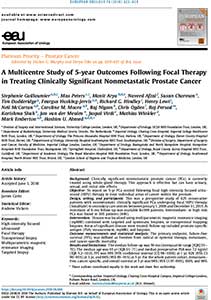
Longer term survival data published by Royce et al, and Emberton et al, indicate survival from prostate cancer is 100% after 7 years. This is known Prostate Cancer Specific Survival or PCFS.
Failure Free Survival is 76% at 7 years and 71% at 10 years after HIFU treatment.
This means that the risk of needing further treatments for prostate cancer are about 1 in 4 at 7 years and 3 in 10 at 10 years after HIFU treatment.Although there are no RCTs or Randomised Controlled Trials comparing survival between surgery and radiation or surgery and HIFU, the published PCFS rates are very similar.
- HIFU is repeatable
Some patients may not achieve complete prostate ablation after the first HIFU treatment, and this would be evident as PSA >1.0 and a repeat prostate MRI scan and biopsy.
This may be due to technical reasons such as prostate size or prostate calcification. However HIFU can be repeated if necessary, with the intention of achieving complete ablation of remaining prostate tissue.
HIFU treatment does not exclude having either surgery or radiation treatment at a later time, should this be necessary.
- Short hospital stay
Patients are taught self care of the urinary catheter before the procedure, and usually only stay in hospital overnight. Patients then return for removal of the catheter within 3-4 days.
Catheter care and removal is under the supervision of our Oncology Nurse in the Urology Suite.
- Fast recovery time
HIFU patients report occasional discomfort, but HIFU is not a painful treatment and the majority of men are back to work or usual physical activity within 2 weeks.
- HIFU can be used before or after other forms of treatment
HIFU can be used as salvage treatment for men who have failed previous radiotherapy treatment.
If HIFU was used as a primary treatment and there is treatment failure, patients can then opt for other forms of treatment such as prostate surgery (robotic/radical prostatectomy) or external beam radiation therapy.
How Does HIFU For Prostate Cancer Work ?
The robotic HIFU probe is positioned into the rectum under anaesthesia. A crystal within the probe vibrates at a specific frequency when an electric current passes through it, and this produces ultrasound waves at 4 MHz.
The ultrasound waves pass through body tissue and some of the waves are reflected back to the crystal producing a real time image of the prostate and its surrounding structures on a computer screen, which is monitored in by the Urologist.
At the same time, by increasing the intensity of the ultrasound waves and focusing the waves on a single point (like a magnifying lens), high energy is delivered to the prostate tissue. This will raise the temperature to 70-100°C and cause permanent tissue ablation (cell death) of the prostate cancer. Dead tissue then sloughs out and is passed with urine.
The prostate gland is carefully mapped out using computer software, to preserve vital structures including the external urinary sphincter, neurovascular bundles and rectum.
HIFU ablation can be tailored to the individual patient’s prostate cancer, utilising the results of Transperineal Prostate Biopsy, Multiparametric MRI scans and PSMA PET scans.
Men with prostate cancer involving several areas of the prostate are treated with Whole of Prostate Ablation.
WHOLE PROSTATE GLAND ABLATION


Use Slider to overlay HIFU Template over MRI Imaging
However, men with cancer in a localised area of the prostate, can be treated with Partial Prostate Ablation. This is sometimes referred to as Focal Prostate Ablation. Partial Prostate Ablation has important advantages for preservation of sexual function including erections. (Ahmed et al)
PARTIAL PROSTATE GLAND ABLATION


Use Slider to overlay HIFU Template over MRI Imaging
Focal therapy for localised prostate cancer
by Dr Kalli Spencer
Professor Peter Royce from the Alfred Hospital in Melbourne prefers a whole gland approach as reported in his study of 70 men with a 8 year follow up. Failure-free survival was 71.2% at 7 years and 7.1% of men developed metastases with median metastasis-free survival of 75.4 months. Whole gland HIFU preserved urinary continence and demonstrated erectile function approximate to a nerve-sparing radical prostatectomy.

Could I Be Suitable For HIFU Treatment For Prostate Cancer ?
Men with localised biopsy proven prostate cancer, who understand the treatment options of robotic/radical prostatectomy, brachytherapy, radiation therapy, or active cancer surveillance, and accept the relatively minor risks of HIFU treatment, are considered suitable for HIFU.
The following are important selection criteria:
- Clinical Stage T1-T2 N0 M0 (localised prostate tumours).
- Gleason score 6 (3+3),7(3+4), 7(4+3), 8(4+4).
- Preferably less than 50% prostate biopsies involved with cancer.
- PSA less than 15 ng/ml.
- Prostate volume less than 40cc and minimal prostate calcification (measured on transrectal ultrasound scan).
- No underlying prostate obstruction to urine flow. Some men require preliminary TURP to remove part of the prostate prior to HIFU.
- Previous TURP even years ago is ok.
- Previous failed external beam radiation therapy is ok, as HIFU suitable for salvage treatment.
- No active disease of the anus/rectum.
HIFU Case Studies
CASE 1
Mr PS age 67 married, occupation farmer, diagnosed with prostate cancer in 2019 with PSA 5.9 and Gleason score 4+3=7 in 8 of 14 transperineal biopsy cores.
Prostate MRI scan reported a prostate cancer in both lobes and very close to prostate capsule and erection nerves, but no spread to pelvic lymph nodes or bones.
This was confirmed with a PSMA PET scan which showed the prostate cancer localised to prostate gland and no metastases to seminal vesicles, lymph nodes or bony skeleton.
His Urology surgeon advised Robotic Radical Prostatectomy, and a Radiation Oncologist advised Brachytherapy Radioactive Seeds Implant as treatment options.
He was concerned about the risks of urinary incontinence ( 5 % severe, 20% with pads) and loss of sexual function ( 50-100%) with surgery.
Initially he was more accepting of Brachytherapy until he discovered that if the cancer recurred after Brachytherapy, then he could not safely have salvage surgery. Brachytherapy also has significant Late Onset Complications after 5-10 years, such as severe bleeding from bladder, urethral strictures, rectal fistula and second cancers in bladder or prostate from the radiation (think Hiroshima and thyroid cancer and leukaemia).
Learning of HIFU treatment from a friend who had HIFU years ago, they advised him to seek further information.
Long story short, he was treated with Whole Gland HIFU Prostate Ablation in 2019.
The HIFU treatment was planned to include all of the prostate gland since the tumour was in both prostate lobes, with careful preservation of the urinary sphincter, rectal wall and erection nerves.
He stayed in hospital overnight, and returned to the Urology suite 3 days later for removal of the urinary catheter. He returned to farming activity 2 weeks later and recovered normal bladder control immediately. He took Viagra tablets for next 12 months and fully recovered sexual function with normal erections.
The PSA level dropped from 5.9 before HIFU to <0.03 after 3 months and 0.05 after 2 years indicating excellent prostate ablation. He remains on 6 monthly PSA checks with no further treatment and normal Quality of Life.
The longer term outcomes of Whole of Prostate Gland HIFU Ablation for Prostate Cancer have been published in Prostate International 2020, Royce et al
CASE 2
Mr LR age 60, married, self employed tradesman, diagnosed with prostate cancer in 2017, with PSA 6.4 and Gleason score 3+4=7 in 7 biopsy cores from a 12 mm prostate cancer at the prostate apex near to the urinary sphincter as seen on MRI scans.
His Urology surgeon advised Robotic Radical Prostatectomy, however he decided to wait and see how the PSA level behaved before deciding on treatment.
He consulted a Radiation Oncologist in 2019 when his PSA increased to 7, however a repeat prostate MRI scan showed a stable 12 mm prostate cancer, so he declined to have Brachytherapy Radioactive Seed Implant.
Later in 2019 his PSA increase further to 9.9, so at this point he decided it was time to have treatment for prostate cancer before it was too late, but he did not want to have a high impact treatment with surgery or radiation.
He then Googled prostate cancer treatment, and discovered the Melbourne HIFU Website
Long story short he was treated with Focal HIFU Ablation in 2019.
His treatment plan included the known cancer at the prostate apex, with careful preservation of urinary sphincter, rectal wall and erection nerves.
He stayed in hospital overnight and returned to the Urology suite 5 days later for removal of urinary catheter. He returned to work activity 2 weeks later with normal bladder function and control.
He used Viagra tablets for 1 year with return of normal erections, and no longer needs Viagra.
His PSA dropped from 6.4 to 1.39 and remains lower at 2.32 after 18 months.
More importantly repeat prostate MRI scans have reported no residual prostate cancer.
Further prostate biopsy or treatment has not been required, and he remains on regular surveillance with excellent Quality of Life and much less anxiety about his future.